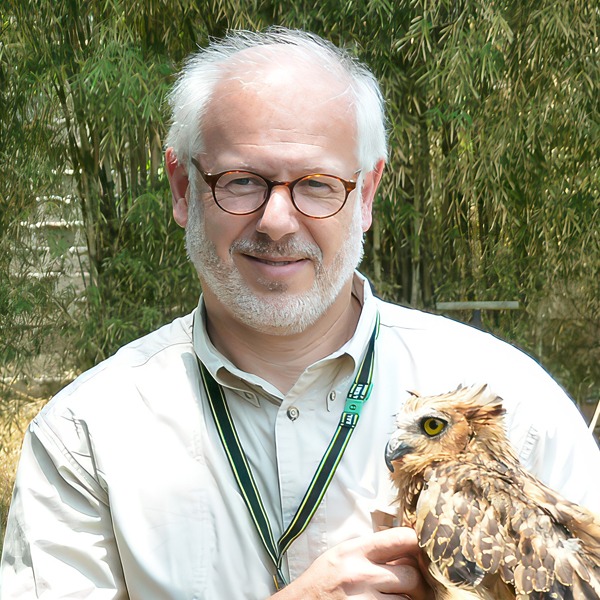
My name is Professor Theo Pagel. I was born on the 14th of January in 1961 in Duisburg, which is a town about 60 kilometers away from Cologne, also on the river Rhine. I’m married, still happily married with my wife Iris, and we have two beautiful daughters. And I’m actually the director and CEO of Cologne Zoo.
We’ll start with what first stimulated your interest in animals or wildlife and eventually being within the zoo profession?
I had no other chance, I would say, because already my grandfather and my father worked with animals, but on a different way, they were both butchers. But my father was also an animal lover, means he was falconer, he was hunter, and he was a very good agriculturist. So we had probably up to 500 birds at home from time to time, and he kept together with me later on, all different kind of animals. So let’s say from small waxbills and lories and lorikeets to specialties of him, and he wrote a book about lories and lorikeets, as I did as well. We kept rattlesnakes and poison frogs and we kept caracal and I bred raccoons and skunks as a student. So I had a lot of experience in keeping animals already when I came into the business. And my father always told me, “You will not become a butcher. You should have a better life.
You should live your profession, your love. You should work with animals in a different way than I do.” And so I was able to go to the university and we lived very close to the zoo in Duisburg. So we were very close friends with the director at that time, Dr. Gewalt and with some of the curators, one of the curators. He lived in one of the houses of my father and I had took care of his private animals. So we very close. And once I came back with a raccoon, they gave me as a present in the zoo. And so I came home with a raccoon and I said, “Oh, I have a problem.
We have a raccoon.” And my father said, “Yes, we have a problem because we need another one. This animal cannot live alone.” So we went at that time and was able to a dealer and bought another raccoon. And from that time on, I bred racoons at home. So I really fall in love. I had a lot of contacts with the zoo community because my parents never had holidays. Instead of that, during the weekends, they drove with me to all the zoos around. So I saw Professor Grzimek, the former and famous director of Frankfurt Zoo in front of his entrance. And I was crying, “Oh, Professor Grzimek, Professor Grzimek,” because he had a TV series, I think from 1956 to 1980 or something like that in Platsfit, a place for animals.
And of course we at that time had to look. It was not repeated in the TV, nothing else. There was no streaming. If you wanted to see animals, you had to sit in front of the TV at that time and we did. So I had a lot of practical contacts. I had already seen what zoos are doing. And yeah, that was my idea. I would say maybe since I was four or five years, I always said, if someone was asking me, “What will you do if you were an adult?” I never said, “I want to be a fireworker or policeman.” I always said, “I want to be zoo director.” Honestly, not knowing what a zoo director is really doing nowadays, and with a lot, a lot of luck, I ended up as a zoo director. You mentioned university.
How do you think your university education and your early experiences prepared you if they did for the position in a zoo?
Honestly, the biology, I studied biology, geography and education. So I tried first to become a teacher because at that time, if you would have gone for a diploma, it was not sure whether you get a job or not. And at that time I already had my family, so I needed money. And then I decided, okay, let’s go for a teacher and then try to get into the zoo world, which worked at the end. And what helps me a lot is that I have learned something about education. Because as a director, you have to educate, you have to educate your staff, you have to take them with you. I’m very happy about that. What I learned in biology helped me to understand biology, but not what I have had to do later on in a zoo, not as a curator, not as a director.
So yeah, education, I think that was the point which helped me a lot in my positions. You said that when you started your career, you didn’t know what a zoo director did.
When you began your career, what did you think were the responsibilities of a zoo?
So when I was a child, I thought they show animals and they love animals and they pet them all the day. And when I was at the university and I already had contacts because for example, in 1988 already, I started a breeding program for the Bali myna and I did that with Zoo Wuppertal, Zoo Cologne and Zoo Nürnberg. So there was a student coming to the big directors and saying, “Hello, I have an idea,” which ended up later on in a European breeding program for this bird. At that time already I was aware we have to do something. So humankind has to do something for nature, for animals, at the end for ourselves because we need biodiversity. And I was aware that modern scientific run zoos are education centers. They are conservation centers. And they’re also research scientists, what many people forget sometimes.
It’s not just recreation or something like that. So from the beginning on, I was aware because I had all these contacts to the zoo people like Dr. Ulrich Schürer from Wuppertal, like Professor Nogge my predecessor, who was a very progressive zoo director at that time, I was aware of the main important and modern goals we have to go for.
What do you think were potentially your most important lessons that you were learning during your early years at Cologne?
I had to learn that you don’t know everything already and that you only be successful if you work with your team. And if you don’t have a team, you have to build it up. So when I started here in 1991 as curator, I got an office and I will never forget my first day because still today and already in that days we did a zoo tour in the morning with a director. So we had a bike and we drove through the zoo, stopped at every department and asked is everything okay and so on. So that was my first day. We ended up here in the office and Professor Nogge said, “Mr. Pagel, I have to work. I wish you a good day.” So I went up to my office, I opened the office and I saw a lot of stuff, but everything was empty because my predecessor as curator, he has taken everything away, destroyed everything.
I only ended up with a small box with some papers, with animal, with some notes, nothing more. So I had to start on my own.
I went to the animal departments I was in charge of and I said, “Okay, now I need to know what do you feed?
How do you feed? How do you care?
Who is the head keeper?” And then I worked with the head keepers that was also something new because at that time there was this change that keepers have much more to say. They are much more involved. So whenever we started to create something, to build something, I asked them because they have to open the doors and close the doors and put in the food. So it’s important that they say, “I prefer it this way or that way.” I will not say that I always did it that way. If I thought it’s better to do it differently, I decide so. But that was my learning. You need a team and with the team you can develop things. And if the team has developed everything together, they will do it.
It’s much easier that they have worked out this and they stand behind it. So I was very happy and that was, I think, the most important learning I had. Don’t do it on your own, do it with your team. The philosophy, it didn’t change. I would say it improved. So in all the different areas we are working in, we are more professional now. We know better than in the past. So just an example, the first orangutan who came to Cologne, he has only a short life in this because my predecessors were not aware how to keep and take care of the animals.
Meanwhile, we know almost everything about these animals. Means what we have learned is that we share knowledge and that is the good thing in my profession that we don’t say, “Oh, it’s my secret. I know how to do it. I will not tell.” No, we share it. And the philosophy is that everyone can learn from the other one and that we have, let’s say, the philosophy animal first. So it’s all about the animals, but we are an institution for animals and humans, but still animal first.
Looking back on your career, what would you say were some of or a difficult decision you faced as a zoo director?
So probably one of the biggest decision, I had no chance. I was once forced because we had an accident with a tiger. A tiger was bitten, a keeper was bitten by a tiger. That was in 2012. I was not on duty. I came to the zoo. I took over the position of the head of the day and the police forced me to shoot the tiger to save the keeper. So I think that was one of the biggest problems I faced. At that time, it was not my decision. I was forced to do so. And all the other difficult decisions were just and only about people.
So if you have work law issues and if you have to fire a person because it’s not working very well, or if you have someone with an alcohol problem and you have to talk with these people and to say, “If you don’t change, you are ill, we have to help you. We want to help you.” I think these were the most difficult decisions I had to do in my whole career. It’s all about people always. It was not do we keep this animal or do we get rid of that because that’s easy. We have an idea behind it. I would say the decisions with and for people are the most difficult ones.
What accomplishments during your career do you think were the most significant to zoo management or conservation?
So for sure, the best things we have invited are the breeding programs. They were established here in Cologne with Gunther Nogge in 1985. The breeding program, zero people breeding programs were established. This gave us a much more professional way of keeping and breeding animals to keep them alive, to save them for future generations. And I think all the structures we have involved that we have now, all the strategies from the World Association of Zoos and Aquariums of WAZA, which lead us the way up to conservation education about welfare. There have been so many changes in how to keep and how to assess the welfare of animals. I think these are the big changes and we can prove that we don’t harm animals. Instead of that, we really take professional care.
We are very lucky here in Germany that a zookeeper is a profession. So three years we teach them everything, they go to school, they have to pass an examination. So in a German zoo, you can say everyone is really a professional because sometimes people say zoos are not good, we don’t take care enough of the animals, and that is not right. We are the experts and we know how to do it. You talked about people.
Your understanding, what is your understanding of the relationship between human beings and captive wild animals that has it changed over your professional lifetime?
What I see is that, especially I would say in the Western world, in the so-called Western world, people lose the contact and the realistic idea about nature. They always think it’s paradise. It’s not paradise. It’s survival of the fittest. And some think that we go out and catch wild animals and put them into a prison, and that is also not right. We take care of animals, mainly all bred already in human care. And what I feel is that people become more and more emotional about animals. And that is not only in zoos, that is also in the livestock industry. They say you can’t keep them this way and you can’t keep them that way or you can’t keep dolphins in a zoo.
It’s all about emotion and mainly there are no facts. And I see that already in the student courses. I’m honorary professor at the university and we teach here in the zoo. So we teach zoo biology and biodiversity. And when I ask the students, “Do you have a problem with the zoo?” With the years, people saying, “Yeah, I have a little bit of stomach problem. I’m not sure. And do you really are able to keep them here under good conditions?” These questions never were raised, let’s say 20 years ago, but they are raised now. But luckily, I have to say, when we show them what we do here in Cologne Zoo, and we have no secrets, we go with the students behind the scenes, we show them everything, we show them our training, we show them our medical training, our research, how we feed them and so on. Then you solve these, I say, emotional feelings, but they’re out there and they’re out there, especially because of the social media.
So if someone is spreading now something which is bad, it’s spread all over the world in seconds. And then people start to think sometimes not the right thing, but just believe what someone has said. And that is not only the matter with zoos and keeping of animals, that is with everything. And mainly, I would say, are the majority of these things you can read in the internet, in the social media, they are fake news. And I hate the word fake news because if you translate it into normal language, a fake new is a lie. So never trust a liar. And I have no problem with people criticizing zoos. And sometimes we need someone to tell us, “Are you sure?” And then we can say, “Yeah, maybe there is a screw.
I have to do a little bit of change.” But normally we do it because we love our animals most and we want to keep them under the best conditions and we are the ones who have really an emotional contact with the animals. So I would say that is exactly what has changed, that there is, let’s say, a feeling is a zoo a good thing or not in the future. We’re in Europe. I want to talk about European zoos.
How would you characterize the condition of European zoos when you entered the profession to compare to what the condition is today?
I would say European zoos, and luckily not only European ones, we have evolved and developed a lot in the last decades. I’ll just give you one example. When I started here in 1991, at 4:30 in the afternoon, we changed our elephants and on the next morning between seven and eight, we let them walk again. No one was complaining. No one was against it, not the staff, not the public. And now we keep our elephants in a matriarch group on almost two hectare area. They are allowed to go in and out even in the winter. They can have bars in the middle of the night. So we try to keep our animals under the conditions now where they can show their behavior, what they do in the wild, and that has changed dramatically.
We have much more knowledge in the veterinarian area, so prophylaxis is so good now. We can allow our animals to live in the dirt, I would say, or in natural exhibits. My pre-pre-predecessor, he loved for sure the animals the same as I do, but he kept them very sterile because they were all afraid that they get ill and that has changed a lot. So how we keep the animals, how we work with the animals, that is another good example. I would say in the old days, you caught an animal, put it in a box and send it away. Nowadays, you do crate training. We got Coquerel’s sifaka from Duke Lemur Center. I saw them there the first time.
Catching training is you put a net on the ground, the animal jumps into the net and you put up the net and turn it and then you open it again. Or he opens the crate, a very kennel, goes in and closes it behind him. We just gave away an elephant last week to the zoo in Munster. We had a four week crate training and it was absolutely no stress for the elephant. He was feeling very, very safe in the box. That is also something what has changed. And I would say following all the strategies of WAZA, zoos in Europe see themself, and I’m talking about the scientific run and organized zoos because we have about 61 of them in Germany, but all over Germany we probably have 700 zoos with the same license. But the scientific run zoos, they really see themselves as a conservation and education center.
I think I said that already, but I think it’s very important to repeat it and repeat it because with this goal, you can see how we work on that. For example, here in my zoo, we are just working on a complete new education system. We want to offer the guests an app, we reduce the information on the plates, but therefore we have same space for English and German. We will offer the people who come with their mobile, then they can translate it into other languages. We will offer them deeper information so they can already almost read a book about the animal, which is not on the plate again, because we know that people don’t read that much, but the ones who want to read more can get more information. We are struggling and discussing how to get the interest of the people because we have a very different age and a very different… Well, let’s say we have an average of the society, so we have to interest everyone, the intellectual ones and the more people who are more interested in recreation or so. So probably it will be a mixture of digital and analog information.
And that is going on in many, many, many of our institutions and that has changed. So we want really that people take something home and what we will do and also how they do it, we will offer the guests possibilities. So we will tell them what they can change at home. If someone is complaining that he doesn’t have insects anymore around his house and he has a garden made out of just of stones or concrete, then I can just tell them it’s easy. Put flowers, native flowers and the bees will come back and the butterflies will come back. So we will try to give the guests information how they can make the world a little bit better. Historically, the European zoos have been established as civic institutions.
How has that heritage of civic institutions influenced their development?
It’s mainly the problem of money. Civic, many municipal zoos, there were days when they had a lot of money and they had to spend a lot of money and with the economy that has changed a little bit. And if I see my zoo here in the middle of the city, we are now facing problems because we cannot at large anymore. So we are in the middle of Cologne, and so that influence a little bit your development. I think that’s the only thing I would say about that.
In what way do you think the destruction and the rebuilding of European cities following World War II influenced the design and the management of zoos?
So the destruction, I would say, through the Second World War was a potential for some zoos and a burden for the others. We here in Cologne Zoo have still some, and it’s the same in Berlin or in Vienna, the old zoos who still have several old buildings. They are protected now. And the challenge is to find a solution to have a very old building, but a proper way of keeping, and even the question, what kind of animals you keep in these houses. So we have the protected buildings. We have to live with them and find a good way like we did with the Arnulf and Elizabeth Reichert House, the former South America house, which keeps now animals from South and Middle America. It’s from the outside, almost 100% the same looking like in 1899 when it was opened as a bird house, but inside it’s a modern way of keeping animals in a way which attracts the attention of the guests and which enables us to keep them in a proper way and to breed several of the endangered species in a proper way, in a much better way than in the past. On the other side, the destruction of the world war and what was destroyed opened the spaces in other zoos to start new buildings from…
So not working with old buildings, but starting already with construction of modern zoo architecture. And what you can see in my zoo as the third oldest zoo in Germany is really the mixture. And that makes, I think, what makes us special. We have the old buildings with a modern way of zookeeping, animal keeping. And on the other side, we have completely modern areas like the elephant park, we call it. So it’s a nice mixture and others like Vienna have many more protected buildings, which also gives them a very nice ensemble and other zoos were completely rebuilt from zero to 100, you can say. And that makes zoos in Germany quite unique. So we are not all the same, which is a good thing.
But of course it was a very, very hard time. I don’t have to tell you.
How was Cologne Zoo affected by the war?
We were more or less completely destroyed beside four or five of the old buildings, and these are already renovated. The last one is the old Giraffe and Antelope house, that is the oldest animal house, animal facility in the zoo from 1863. And there is an enlargement from 1870 where we kept hippos from 1870 till 2010. That is the only one which is not renovated, but we are already in the planning of it. And this will become not a real animal house, but an information and conservation center where we will have information about the projects, about the zoo history, about the work we are doing up to a VR right to our projects. So we are producing now two films of two of our projects in Eswatini in Southern Africa and in Vietnam. And so we will take the guests with us and show what zoos are doing outside the walls of the zoo. And I think that is a very interesting thing.
We will have some animals in as long as we are in the planning, but it’s mainly not an animal house. And all the other protected buildings we have are 100% animal facilities, and that worked very well.
Have there been European zoo directors, maybe in Germany specifically, that have had a great influence on the development of the modern zoo?
Of course. I think the most important one was Klaus Hagenbeck. Probably everyone in the zoo world knows Klaus Hagenbeck, Tierpark Hagenbeck, the zoo in Hamburg. He was, I think, opened in 1907 or something like that. And he had a great, great, great influence in the development of modern zoos because he had the first, let’s say, wireless zoo. So he had a construction where people, the guests, got the idea that the animals are living free ranging. So he had dry molds and the bart cages were separated just in the back. So he influenced, I think, most the construction of the zoos because before him, animals were kept in cages, in classical cages. Sometimes they looked like a prison for humans.
And that was not because they didn’t like them, but they kept dangerous animals. So they had to be aware that the guests were not harmed and the staff was not harmed by the animals. Therefore, they had these classical cages. But Klaus Hagenbeck, he invented this natural exhibit and you can still see that everything is protected there. And I show always the picture to my students in the zoo biology course where you can see the birds, the waterfowl, the flamingos, behind that you see the hoofstock, the zebras behind that you see the lines and then there’s a rock and behind the rock you see some goats and other hoofstock. And you think you are in a paradise. But of course they were never together. They were all separated with these malts.
I think that was one of the biggest influences. And the other one for me was, because I grew up with him, was Professor Grzimek. He was the most famous zoo director for a while. Many people have forgotten that he has saved together with the president of Tanzania, the Serengeti. He’s the only one who won ever an Oscar from a whole profession. I’m still working on that. And I think he was in a very special way influencing because even Franklin Zoo was a small zoo. At that time, he was probably one of the most famous in Europe because he had the TV series in Germany. He had a magazine called Das Tier, “The Animal.” So he was going outside the zoo.
He was a superhero for the zoo world at the time, and unfortunately we were not able to replace him when he at the end died. And he already started to do a lot of for conservation. As I said, he was the one who is responsible that we have more animals now migrating in the Serengeti than we ever had before and especially at his time. So he was a visionary. He invented his support association for the zoo called Zoologische Gesellschaft, Zoological Society of Frankfurt. It was originally an association supporting the zoo, but he changed it. And it’s even today, unbelievable, that would never happen again in a German TV show if it is not for helping people with cancer or something like that. But Grzimek ended always telling, “And if you want to support, please, here’s my bank account.” And people spent huge amount of money.
And now the Zoological Society of Frankfurt is a major player in conservation and that is connected with the zoo. So he was, in my way of thinking, he was a visionary. He lifts, let’s say, the exhibiting animals like Hagenbeck. He had one of the first dark houses where you can go and see animals living in the night. And he was going out. So having the magazine, having the TV series, working for conservation, that was a big changer. And another one is a good friend of mine, that is Alex Rübel. And Alex Rübel was the former director of Zurich, Zurich Zoo in Switzerland.
And he really developed the Zurich Zoo to a conservation focused zoo. And he was the first, and that’s one of the most impressing exhibits for me in my career, that is Masoala. Masoala is an area on Madagascar, and he built a Masoala hall just for animals from Madagascar. And it’s a huge tropical house you walk through and you are in the nature. There are small animals and bigger animals and birds and reptiles and amphibians, and you really go on an expedition to Madagascar. And he lives, I say, what we invented a little bit later, the one plane approach already in this Masoala hall, because they not only built this big tropical house, Masoala , with all the malagasy animals, but they have a conservation project in Masuala and they have original plants and they support the work over there together with him. I was for a long time now in the Madagascar fauna group. He brought Cologne Zoo, me to the Madagascar Fauna Group where we together work for the conservation of malagasy animals.
So he was a big changer. He was president also of WAZA and he pushed the zoo world also in the direction of conservation and of, let’s say, I would call it already edutainment, how to edutain, educate people with such beautiful constructions and exhibitions. You mentioned the word WAZA.
Would you explain what WAZA is?
And then my second question is how has the European Association of Jews and Aquariums started to…
Has it changed relationships among European zoos?
So WAZA is the world association of zoos and aquariums. That is the global umbrella. We always say there are the leading zoos of the world coming together. And for me personally, not only because I was once president of WAZA, this was always the think tank because WAZA worked on the strategies. So they said there are four goals we are going for. They did it already in 1993. So a scientific run zoo organized zoo has the goal to work not only for recreation for the people, but he has to do conservation, he has to do education and he has to do research. So this was written down 1993 in the first zoo and aquarium conservation strategy.
And that is important for me because in 1999, the EU brought up an EU legislation for zoos. And in this legislation, you find exactly that a zoo has to work on conservation, education and research. That means that we, as the world zoos and aquariums, we were aware of these goals which we have to fulfill now in Europe six years already earlier than the legal body. So I’m very proud of that. And then WAZA is also doing other big strategies. We are working on the welfare. There’s a welfare strategy. We are working how to globally work with the animals. And of course we are very, very, very close connected meanwhile with the IUCN, which is the biggest nature conservation association of the world.
Many more than 11,000 people are giving their brains to this community. And that is what brought us very close to the conservation world because the leading zoos are conservation organizations. So that is WAZA. And of course, they follow also as a regional association the goals of WAZA because if you want to be a WAZA member, you have to be a member of the regional association, you have to be an accredited member that has the reason that you need to be accreditated, that you have to have certain standards, and then you can be a member of that. And the AZA is taking more care of the practical work. So how to run the stud books. They have the taxon advisory group like you have in the United States, like you have in Australia, like you have in Asia. So EAZA has worked to bring the different cultures of zoos, I would say, because we have many, many different cultures in Europe together and to raise certain standards and go for it.
Have there been any husbandry practices that you feel started in European zoos, if any, that have influenced other zoos worldwide?
Oh, that’s difficult to say. I think husbandry came up in other areas as well, how to keep animals improved. And I think luckily because of the World Association and the regional associations are taking part of it and influencing WAZA as well and bringing in and out the knowledge, that was not just in Europe the way. So I would again say in the Western world. Now I would say there’s a lot of going on in the Eastern world, especially in Japan and in China, there are so many new zoos and especially aquariums which develop husbandry in a very proper way and developing and improving. So I would say there’s nothing special I could say for Europe, which is so outstanding that you don’t find it anywhere else.
Would you say there are any European zoos who historically need greater or should receive greater recognition by the zoo community?
What means recognition?
I think, as I said before, one who has influenced the zoo world very much was Tierpark Hagenbeck. I’m not sure whether the young generation is aware, still aware that Hagenbeck was the game changer in exhibiting animals. Maybe that should be recognized a little bit more and for sure it is Vienna, Vienna Zoo, which is still the oldest open zoo, I think from 1752 or something like that, run by one of my friends, actually Stephan Hering-Hagenbeck. I hope that Vienna gets enough recognition because they are one of the oldest, but on the other side, one of the most modern zoos still keeping the whole ensemble. It’s UNESCO world heritage site. So it’s very, very difficult for Vienna to improve in the way they would like to because they have all these protected buildings, but they do. And that is something which you can show. And there are many, many others I would say who should…
Oh no, I would say everyone should be recognized. So political. But you lead into something.
What would you say are important aspects of European zoo history that may be in danger of being forgotten as the older generation of zoo professionals retires?
So what makes me stomach problems is that with all the improvement, all the welfare training, medical training and all the kind of stuff, which is totally excellent, but on the other side, we lose the knowledge how to catch an animal. We lose the knowledge how to catch an animal and just to give them a vaccination. Everyone nowadays is asking for the veterinarian to bring the animal down. And as we are not that much responsible, as we are not that much dependent or we are more regulated I would say by the breeding programs, we lose some knowledge of hand rearing as well. And on the one side, I have to say it’s totally fine with me, but on the other side I’m afraid and I’m one of the old ones, if the giraffe don’t works that well, I would know what to do kindly enough to put it on the crate. That is something I fear that we may lose it. We had a curator here and she reared, I don’t know, hundreds of primates and instead of publishing her knowledge, she threw everything away. And that is a miss because if we get in the situation, normally we don’t hand rear animals any more in that number, I would say, as we did in the past, but we should still know how to do it.
And these old practices, and I still remember when one of my old keepers retired quite recently and he was responsible for the great apes and I asked him, “So 40 years ago when you moved the animals from the one house to the new house, how did you do it?” And he said, “Oh, that was no problem. I took one on the right arm and one on the left hand and we walked over.” If I would ask one of my staff to do so, I would be in prison already. Of course it’s forbidden because they are dangerous animals and so on and so on. But this guy, he had experiences no one will get from the new generation. And I think it’s important that you don’t forget this and that you write it down and that you have, if you need to do, you can take a sheet and say, “Ah, if I have to hand rear this animal, I can do this and that way.” So that has changed dramatically, which is not a bad thing at all because now we keep them more natural and so on and so on. But still sometimes we need to hand rear because they are so important and if it doesn’t work, and this is one of the last ones you have to do so. I want to talk about zoo design.
How has your philosophy of zoo exhibit design evolved over the course of your career?
I would say my personal philosophy didn’t change that much. It was always animals first. I built for animals. They must have a good life in the exhibit. But on the other side, my philosophy has changed because it’s still, and I repeat myself, animals first, but the animal is here also to work as an ambassador of its species. That means I need to get the interests of the guests. So my philosophy has changed in the way that I said I built it first, the exhibit for the animal, but I have to build it in a way. And therefore since over 20 years now, we involve always in the exhibit construction, the educators.
And we ask them, “What is the story you want to tell?
How do you want to tell?” People must have interesting views and attractive things to do. And as I said before, the welfare has improved so much because we do much more than in the past, especially with behavioral enrichment. So if I build a new exhibit, I can already think about the enrichment I want to do with the animal to get the animal fit and healthy, but on the other side, to show something behavioral to the guests. So that is, I would say, the philosophy, it’s for animals and people now. It’s still animals first, but people need to be interested and people need to see animals in a proper way. And you talked about animals first. Historically, zoo exhibits, as you mentioned, were designed primarily to make animals visible to the public.
How should modern exhibits balance that visitor visibility to see animals with the animal’s needs for privacy or choice?
That depends on the animals. And of course you can do it in a proper way. If you do it in the right way, you have the win-win situation. For example, if you go to our cheetah exhibits, we know that cheetahs want to have an overview. So they like hills to stay on and see where the hyenas are coming and so on. Even in the zoo, they do so. And what we have done is quite easy. So we build up hills. That means I know that the cat will lay on the hill much better to see for the visitor.
And now we have a heating platform in this small hill, in the enclosure, which attracts even more the cheetah in the not so nice winter area to lay on the hill. So people can see the animal, it’s good for the animal, and you can have many, many of these kind of things. If you feed now or you have feeding areas for the primates or even the tree climbing bears in the trees or in the constructions you offer them to climb. Or if you have nets, nests where they sleep and you put them in a level where people can see them, then really laying there and playing there, I think there are many, many tools which can help to do so. So better and more interesting exhibit for the guests, but on the other side, very, very good for the animals. Sometimes people make mistakes.
What would you say is the greatest mistakes the zoo architects and exhibit designers continue to make?
The biggest challenge I always had with architects talking about them, they want to have architecture. And normally there are exemptions, even in Cologne Zoo, 2004, there was the decision made to have a nice building for the elephants, not a practical one, but normally you want to have practical houses and exhibits and it’s not about architecture. There are other examples like Copenhagen, Norman Foster and other architects, very famous ones, they have built animal exhibits and houses. That’s true. Here in Cologne, we have this elephant house, which inside looks like it’s the tree canopy staying together and the columns on which the roof is standing. They are the trees. Outside there is skin of elephants in a concrete wall placed. So it’s architecture. And I think that has changed. In the old days, we built exotic architecture, and you can see these in the old houses we have, the South America house, the old elephant house, even the house where the directors were kept, the old villa, they are exotic.
And now we build natural exhibits and they are exotic, but they’re exotic because they look natural and they offer much better areas for the animals. Well, you say naturalistic.
Should naturalistic exhibits design be the objective or are there situations that the natural environments better serve animal welfare?
Should they always be just naturalistic?
Or are there certain situations where – Honestly speaking, often we build naturalistic exhibits for the eyes of the guests, not for the animals. From my point of view, it is important that the animals can show their behavior, and it doesn’t matter if you have an oak tree, a birch tree, or a metal construction for the orangutan to climb on, but the animal needs to climb on. But it gives you a better feeling and it looks much more natural and gives you the impression how animals live in the wild if you have a naturalistic exhibit. But backstage, often we still have the more practical and let’s say steel and stainless steel and concrete constructions which can be used to keep the animals in a proper way. So the animal has no problem with wire mesh. We have it because people think it’s a cage. Ooh, a cage is not good. If you have a glass front or if you have a dry mode, then they like it much more.
For the animal, the wire would be much better because it can climb on it. So I think you need a good mixture and that is what we try to do here. So where people can see the animals, it’s the area which looks very nice and people feel good for the animals. And in the backstage, you normally have more practical and constructions.
How important is space, physical size of an enclosure compared with the complexity management of animal choices?
Space is important, but quality is more important than quantity from my perspective. You need a minimum space for certain animals. You can have mixed exhibits. So you have the same space, but more space for more animals. Many of my colleagues are working the way more space for less animals. That is not always necessary from my perspective. We have built the Hippodom for the crocs, nile crocs and the hippos, and they are now living with hundreds of fishes and birds and reptiles. So there was more place for more.
But the quantity is not the reason you build something, you need to have the quality.
So what is the need, what is the behavioral need of the animal?
So if someone needs to climb, you’d have to offer someone something to climb. If you have a huge tropical house without any construction, the origin will be very sad. If you have a smaller one with a lot of trees and climbing possibilities, you will be very happy. So it’s of course a minimum quantity and size you need. Or not say minimum, a certain space size you need, but it’s not the larger, the bigger. And that’s one of my birds calling on my clock. Sorry for that. I think I was working for the German government on the minimum standards with welfare people in there, and they said that the separation stables for zebras and other white ass should be much bigger than it was planned. And they said, if we would do so, you will harm the animal because their behavior is if they are afraid, they run away.
So if you make the separation areas too big, they may break their neck because they run against the wall. So a little bit smaller is in that case sometimes better, but of course they need the quality that they then can decide whether I want to go in and out and have the huge outdoor space where I cannot run against the walls and so on. So it’s mayor and mainly quality instead of quantity.
Do you think European zoos generally have been more willing than American zoos to construct large indoor tropical environments?
And if so, what do you think accounts for the differences?
I would say you can’t say that in this way. I would say It depends. I have seen tropical houses in the United States and I have seen them here in Europe.
It depends a little bit where you are. What is the climate?
What is the climate zone you are living in?
I think you find them in the US, you find them in Europe, and we should not forget you find them everywhere else in the world meanwhile, because it’s not only us, the US and Europe, there are many, many, many other facilities. I think what the big houses offer you is that, especially if you have a real winter like we have here in Germany or you in many areas of the United States have, then you have something for the people in the winter to go in. And these big houses, it can be a desert, it can be a tropical house. They normally offer the people a very nice habitat impression. And of course, it’s a matter of cost. I think you need the money to construct something like that. And that is, I think, the main reason why you find some of these houses in this or that zoo. You mentioned the elephant exhibit in Cologne.
So it’s kind of a twofold question.
How have your experiences with elephant management influenced your thinking about enclosure design, social groupings and animal welfare?
And do you think that European zoos will be able to maintain and justify keeping elephants 50 years from today?
Okay. So management, we have learned that you can keep elephants, and we have a good example here in the elephant park at Cologne Zoo, in a natural way. Means we have a matriarch group. We have the ability to keep two adult bulls. We keep them in a fusion concept. That means we separate sometimes, we bring them together. So they can really live naturally. What we have learned is that you need a lot of flexibility because it’s a social animal. A social animal, unfortunately, like us humans sometimes don’t like each other.
So we have to be able to separate and bring them in again and take care of all this kind of stuff. Since 2004, we have the elephant park. The first birth was 2006. We allowed all the animals to give birth in the group, a big change in elephant keeping history. We’ve learned that this trains the young females, so they’re totally relaxed. They get the support from the aunts, from the mother. On the other side, we learned some mistakes we made. It’s not enough to have one entrance for a water basin.
It’s better to have two because if the calf falls into the water, for 100% sure it will not swim to the area where the exit is, but to the dead end. So when I started as director, put every basin now with an entrance and an exit on separate areas. And the elephant will show you the weaknesses of your construction very, very fast. So when we got the big bull, we were not aware that he will stand on his hind legs and reach out one and a half meter further than expected. So we had to rebuild all the video cameras. We had to remove two platforms because it was able to reach out. And I think another question, a thing we learned, if you have doors, you need always have ability to open the door or work on the door if it is not working. So if you have a separation area, you cannot work when the door does not work when the elephant is in, especially if you work with them like we do in the protected contact.
So you need enough doors, you need enough flexibility. And what we learned is yes, you can keep elephants under proper conditions and they will not show stereotypic behavior. We have sometimes stereotypic behavior in our elephant group, but these are the ones we imported from camps in Thailand or Myanmar. But all the offspring does not show any kind of stereotypic behavior because we do so many enrichment, because we do keep them in a social matriarch group. And to come to the difficult question to look into the future, I think the problem if we will keep elephants in 50 years is not the public. It is us and it is money because we have meanwhile so high standards of keeping elephants means the taxon group of the Aza for elephants says you need to keep a matriarch group, you need to keep two adult bulls and you need to keep a bachelor herd. So we don’t have the possibility to keep a bachelor herd. We have just the two bulls on the matriarch.
We were constructed in 2004. If you fulfill these demands, then we talk about 60 or more million euro per exhibit and there will be not that many zoos able to spend so much money for one species. And I think then we would reduce, I don’t know, we will fall down to five to 10 institutions in Europe keeping elephants and that would not be enough to keep a proper population. So what we have to think about is that we still go on and say, okay, do it like Cologne. You have two bulls, that’s good. Matriarch group, expensive enough. And the bachelor groups will be somewhere else. So that has worked for a long time and I think that is the situation we will face.
I really hope that the public will see the need to show these animals because they’re ambassadors. I’m also in the Asian elephant specialist group of IUCN and are offered already to the range countries that we would be able to send animals back. They have no interest because for many range countries, elephants are not fun. They are a problem. We have to face that as well. But with the elephants, you can tell many, many, many stories and many stories which are crazy and you cannot understand. For example, I know actually in Kruger National Park in Southern Africa, there is an overpopulation of the African elephant probably of about 30,000, 30,000 elephants. And if they don’t solve this problem, that will be a problem for elephants and all the other animals living in this Kruger National Park, which is at the end also a zoo because it’s fenced so the elephants cannot move. And we have to face this.
And with elephants, because they are so charismatic animals, you can reach out to people and you can get even sponsorship for all the small and ugly animals no one is taking care of as a zoo. So I think if you keep them under proper conditions like we do here and we have now 15 offspring, we could have bred many more. And by the way, because I’m so much in love with animals and I was a little bit sad as director to lose the content, I did the elephants for 15 years, so on my own as steward. I just got rid of them because I really retire now my vet, Sandra Marcordes is in charge of them. But elephants are a great storyteller and therefore I really hope that people will also be able to enjoy elephants in the future and zoos because most of us will not be able to see them in the wild, whether in Asia or in Africa. You mentioned that elephants were charismatic on a side thing.
Why do you think elephants, animal rights groups are more concerned with elephants than they are with a Nile crocodile?
Emotion. It’s emotion. And of course, let’s say this way, I got the impression that anti-zoo people charge us because if you charge a zoo, you get public awareness. And if you would start and say you should forbid to keep mullets in a zoo, no one would be interested. But if you say stop elephants, you get the intention of the media. I’m not always sure whether that is really, that they are convinced about asking that, but maybe more because they get attention.
As we talk about zoo design and Cologne Zoo, is there one exhibit or maybe others that you would say, oh, very successful in zoo design?
And why would you say that?
So I would say two exhibits I would like to give you as an example. So one was the tropical house now called Dragon House where we keep Komodo dragons since this year, because this was one of the first constructions where we were all involved from the beginning on, the educators, the curator, the director. And there was a red line from the beginning on.
What did we want to tell?
So you enter the house, you come to a room where you get the first information about the rainforest. It was at that time Indonesia rainforest. We showed the people the problems of the rainforest. Then you enter a free flying, free swimming, free jumping area with only a few signs where you really have to experience wildlife. You are in the wild like you would be in Thailand, in the jungle. You have just your book to see which kind of bird is flying around me. And then you come to an area with separated animals in separate cages or exhibits, better to say, because they have glass fronts. And there were animals which could be harmful for the guests, harmful for other animals or which are so delicate to keep that we said it’s too dangerous to keep them in the walkthrough area.
So the immersion exhibit, you leave and then we make sure that even if you haven’t seen that many animals in the tropical area, the walkthrough area, you see for sure animals in the separated end. And then you end in an education room, which will be renovated quite soon. And then you give you a lot of information about the rainforest, about products of the rainforest, what you have contacts with, you are not aware of how important the rainforest is because some people think I’m so far away from the rainforest. If they cut the trees, doesn’t matter. It matters. We all know that now. So this is one nice house and I mentioned it therefore because we have renovated it and instead of having an exhibition hall, we have now a breeding station, a breeding station for very endangered South American birds. We have this here in Cologne. We have paid for breeding facility in Prigen on Java, and we are running a Center for Species Survival. And Dr. Markov is running this as an officer and he’s taking care to work with the Asian Songbird Trait Specialist Group taking care of these animals.
So this is also a one plan approach building, you can say, where we have everything, education, we are able to do research and we have in situ and ex situ work combined.
And the other one is, I would say, for example, and of course I could tell you many more than two, the Arnulf and Elizabeth Reichert House that is the former birdhouse from 1899, a protected building where we said, how, what can we do?
And we were able to take out the floor of the house. And now the plants grow from the cellar up to the top and you’re going through the house on a runway through the house. The animals come very close to you. And what this house showed to me quite nice is that you don’t need the $200 million tropical houses to get people attracted. It is how you show the animals and how you construct the house. Sometimes I think it’s too small because people don’t want to leave. They stay there because the animals, the primates, the birds, they come very close to you. You’re in the middle of it and you see them because it’s not so big as other tropical houses.
And here as well, we have a conservation project that is one of my rules. Whenever we invest a lot of money in a house, we always try to connect it with the nature conservation project. Therefore, we are working with other zoos in Belize, with house. And with the now so-called dragon house, we have added even not only the breeding of the songbirds, but we have now the Komodo dragons and we are supporting the in situ work for Komodo dragons. And we have another area we are focusing on. It was formerly Vietnam and Indonesia and it’s now Indonesia because Vietnam is happening now with all the projects in the aquarium. But we are now in Papua New Guinea because we have supported the Center for Species Survival together with the IOCN and the Nature Park in Port Moresby. And we are the main sponsor to run this center in Papua New Guinea for the endemics of Papua New Guinea.
And you’ve talked about Cologne, but would you say, are there other European zoo exhibits that you regard as influential or innovative in changing the direction of zoo architecture?
Again, I have to say Hagenbeck with the Tierpark and the let’s say wireless zoo, we call it sometimes here in Germany. For sure it was Masoala. It was one of the big constructions. There are other zoos like Leipzig, which have built many, many, many new exhibits which are leading like Gondwana where people even have the possibility to sit in a restaurant and have a boat trip and really enjoy nature and have a good life as well in there. So these are the ones I would say. And another park I haven’t been to for the last years, but I know that there’s a lot of going on is Pairi Daiza in Belgium. They invest a lot, a lot of money. Obviously they just have opened the largest tropical house you can find where you find amenities, you can sleep in this building.
And I would say probably in every zoo I’ve been, because I never say that is the best zoo, I always ask my question if I visit other colleagues, what is the exhibit which is in the wrong zoo?
That means not a mine.
And I think I always found one minimum where I said, “Oh, that is one I would love to have.” Do you feel that the, you talk about immersion, do you feel that the immersion exhibitory is the best thing for animals rather than observing them traditionally for people and the animals?
In a way, immersion exhibits are taking you on a journey to the nature. So yes, they are normally more attractive, but on the other side, they are very challenging because you need to be aware how the animals behave. And sometimes you have species which work very well, but one individual doesn’t work. He gets aggressive to the visitors and so it’s a challenge for especially the keepers who work there every day who know the animals very well, or you have to say, “Now there is one species breeding in this corner and I have to close this because they will protect their offspring and their nest and so on.” But on the other side, there are animals you cannot keep in an immersion exhibit or very difficult. So it’s important to have a good mixture of immersion and let’s say classical exhibits. And you mentioned about costs. Is construction operating costs continue to increase.
How do you think zoos can reconcile these ambitious architectural objects with limited financial?
It will be the challenge of the future. So you may know this year was not a good year for almost all zoos in Europe, probably in other areas as well because the economy and especially the extreme weather conditions we had. So we had less visitors.
And the question will be how do we construct in the future?
Is there not a more easy way to do so?
And then you have the differences between the different countries. So I have been to Singapore quite recently and saw the new bird park with these huge aviaries, wonderful huge aviaries, which normally I would be able to build, but mine would cost probably three times because in Germany they will say, “Okay, there may be snow.” So you have to construct them in a form that one meter snow can lay on the net and then you cannot pay for that. The question will be, because many of us use stainless steel now because it’s so nice and stays long, maybe we have to go back for some of the birds to have nylon nets and others cheaper materials. So we have the challenge and that is not only for zoos, construction is very expensive for everyone, even if you want to build a house nowadays. And I hope that this will normalize again because if they would stay like that, no one would be able, and I don’t talk now about the zoos, to build a house on its own and pay it in its lifetime. And also the public constructions, the bridges and so on and so on, they will not be able to renovate because there’s nowhere enough money. So I hope that will normalize. And then for the zoo world, I would say yes, we have to think about alternatives.
How and what do I do?
And it’s not always, and I said that with a Reichert house, you don’t need the biggest house on the planet to get the people interested and not to have the biggest house to keep the animals in a proper way. So maybe we do smaller things, but very effective. On a side note, I know that many European zoos have what I would call housing for scientists, temporary things for people to stay overnight, but that’s very rare in the United States.
Do European zoos still maintain that philosophy of having a place for visitors to stay, scientists or people that are needed temporarily in the zoo?
I think that is very individual. That is not generally to say. That depends really on… We have, for example, the Max Planck Institute working in Leipzig Zoo with the great apes. So they are part of the zoo. We work very closely with the Institute for Zoo and Wildlife Biology in Berlin. So this is working with many zoos. Some of us have room for people. We have room and we work mainly with students who do research for us here in their university work, but others don’t have that and others have double what we have.
So that’s a mixture. And I wouldn’t say that it’s not the same in the US. My impression was always that in the US they have many, many, many more veterinarian facilities and research and that.
So if you were given unlimited resources to design a new completely zoo, complete zoo, what would you do differently from the way zoos are being constructed today?
Yeah, that’s a dream question. And honestly, I have to say that’s very, very hard to answer.
I would probably ask myself first, what is the story I want to tell?
What are the four key I want to put my interest in?
So is it, let’s say Indonesia, is it more native?
And depending on that, which story, with which species I want to tell and what are the goals I want to fulfill with in situ and ex situ and all that kind of stuff, then I would start to think about it. But for sure, the most important thing is I was never able to move Cologne Zoo to a better climate zone. But for sure, if I would have the possibility, if someone says you get everything you need, I would choose a nice place. I would choose a place where I have less winter means less costs. I have better plant growing. I have more good circumstances. And on the other side, I have been to the UAE and other countries which are very, very hot and they have zoos which are air conditioned and you look outside, I wouldn’t build a zoo there because, and I always was frustrated when I visited, for example, Animal Kingdom and they can cut the plants as fast enough as they grow. And I always felt that’s unfair.
On the other side, honestly, it has a favor. If you have zoo in a place like we have, now it’s starting to get winter time. We are in the autumn. The trees loose their leaves. It’s another view. It’s another impression of the zoo as well. So that can help you as well to be attractive and change especially things for people. And what I for sure would do, if you would give me this money, I would say I want to have an outside zoo. I want to have a station outside the zoo. I would like to have a facility where I can deposit for a while surplus, so-called surplus animals or have a breeding facility for hoovestock, which I don’t have actually here in Cologne.
So for sure I would have this. But in general, I would stay with the classical conservation education center.
And have there been in your career Cologne Zoo exhibits or things that you wanted to do but just didn’t have the opportunity for whatever reason?
I always would have loved to keep platypus. That’s my favorite animal. And of course we were never able to get them. There’s only one place outside Australia, but it’s such a crazy animal with the bill eggling and it’s crazy. So I would have laughed once to show people here in Europe platypus from Australia when there was a dream. And sometimes it’s good that dreams don’t come true and they stay a dream so you can go on dreaming. We’re here in Europe, American zoos, European zoos. Some questions about philosophy and operations and culture.
What do you consider the most significant philosophical differences as you’ve observed them between European and American zoos, if any?
I would not say philosophy. I would say what I learned or my impression was from the beginning on, I was first in 1984 in Florida. It was my first state I visited in the US. And I was of course there in the Sea World and other parks. And I got the impression that the expectation of Americans because of a different cultural view may be the difference.
It’s not the philosophy, it’s what do the visitors want?
And what I saw is that expectations are getting more together. So the expectation, I think people going to a zoo now in the States is more like the one here in Europe nowadays or the other way around. When I started my zoo tours in the US, it was that US guests were looking forward to see a show and get more entertainment. But what I saw On my last trip this year in Chicago and St. Louis, that now also in the US, people want to see the good things zoos are doing, conservation. Of course, they want to see animals, and that is the main reason why people come to our institutions. But I think the philosophy is more that both in the US and in Europe, and I would say in all the organized regions, scientifically run zoos, we want to get the awareness of the people. We want to teach people in a nice way, not with a finger, but give them more information about nature and the importance of keeping biodiversity for humankind, the future of humankind.
I think that is what I would say. Philosophy is more common now because expectations are closer. That is my feeling. I can’t prove it. There’s no science behind it. And on the other side, the philosophy was not that much different.
Do you think there are fundamental differences in how European and American zoo directors define the mission of the modern zoo?
I think you can also not say that in general. It depends on the possibility you have. And that is a mixture in the US and that is a mixture here in Europe as well. That depends mainly on what you are able to do.
Are you a municipal zoo? Are you a state owned zoo?
Are you a private organization?
And I think that gives the directors the possibility or the chance to do it this way or that way. If you have a different idea, but you are changed, I would always say, by the organization, then yeah, it’s difficult. You mentioned private organizations. The Cologne Zoo is a very old institution and has been around.
When you have private institutions owned by individuals with money, what is your thoughts?
Do you feel that’s worthwhile?
Will they be there as long as the Cologne Zoo?
Or are they just benefiting because of an individual who will, if not there, it will not continue?
And what’s the place of those zoos?
Also there, it depends on the institution and the people running it. Think about Hagenbeck since 1907, that means only 47 years younger than we are. They are still existing and they are a modern zoo following all the goals we are going for. And then it depends who is the owner. A good friend of mine, Cesare Avesani owned Parco Natura Viva in Italy. He’s now retired and he sold his zoo to another investor and he was doing a proper job, a great job. He was one of the best zoos, maybe the best one in Italy, doing a lot of in situ and work, a lot of conservation and even research. I think it’s more important that you are a member of these regional and global associations because then it doesn’t matter whether you’re municipal, if you are owned by one person or a family, because then you sign that you stay and stand for the ethics, the goals, and then it doesn’t matter who is running the institution will follow this path.
And that is very important. And I think there were municipal zoos who didn’t work and there were private guys who didn’t work, but in general it works because you get the information, you get the leadership by the organizations where you have to go to.
Do you feel that the European zoo’s approach animal welfare and husbandry different from practices that you’ve observed in American zoos?
I would say if we say welfare practice is also medical training and training in general, the United States were faster than we. So training I saw much earlier already in the United States and I was very impressed in Lincoln Park Zoo quite recently, what they do with their animals, how they build their exhibits, and it’s more an individual than let’s say a country-wise difference.
Do you think European zoos have greater emphasis on maintaining genetic sustainability than American zoos or the same?
I would have said a decade ago we have both the same. And now I would say we are facing both the same problems because I’m aware that the United States, AZA had to cancel several SSPs, so breeding programs because they were not sustainable anymore. And we thought in Europe we are much better. And now there is some research done by Marcus Klaus and others and they show that we have in several of these breeding programs over aging populations and that we have to face that and that we have to find solution. If we don’t want to quit breeding programs and we want to keep proper populations and in Europe, and I think it’s the same with the SSPs, you normally say it’s for hundred years you want to have the greatest genetic diversity you ever can get or keep. That means we see now I have a problem and now the question is how to solve this problem. If I see I have an overaging population and we have that here in Europe with many countries with humans and that may cause a problem for pensions of many of us, then we have to start thinking and that is the same with the animals. So yes, EAZA is now in a big discussion and we brought this topic also because it’s not regional, it’s a global problem.
We brought that to the last WAZA conference here in Cologne and said, “Look, overaging populations, we want to keep the animals alive. If you want to save the species, you need to have a proper self-sustaining population. And then we have to face the problems, the challenges coming.” We were comparing things with America and Europe.
From what you know, how do you think, if at all, the European endangered species program compares with the species survival plans used by American zoos?
In general, they’re very, very similar. The only difference I see is that we are now aware that some of them are not functioning and that is unfortunately the same in the US as in Europe. And that is, I would not call it mismanagement, but unfortunately we still have in both associations people who take care of such programs and are not efficiently enough and not working enough, not replying fast enough. So I don’t will tell any names, but for example, we asked already for several years that we are interested in certain species and then we don’t get reply. We plan for the species and now after two, three years, then we get a feedback and that’s a big problem. So we have to take care and that is something, for example, the EP committee is doing. I was also part of the EP committee. We evaluate how good are the programs run by certain people and it’s wrong that you raise your hand and don’t work.
So if you say, “I want to run such a program,” you have to do it. And that is very, very, very important. Otherwise, we face problems.
A side question in Europe, if I wanted to have a certain species of bird or mammal that was not listed with the European endangered species programs, would I be free to bring that animal in and not worry about the listing of species that you should be keeping and breeding or would there be objections?
So within the AZA, we have everyone who is running an institution has to have a so-called species plan. That means you should know why you keep which species. And then you get the recommendations, same in the US by the taxon groups. They say we will concentrate on this animal and that, therefore we have now Goodfellow’s tree kangaroos instead of Matschie’s because I said Matschie’s will be done in a different country, not anymore in Europe. But we are still, and that is good from my point of view, able to take animals which are not listed. And here in my zoo with about 800 species, for sure we have many who are not listed. And if we would take all the same species, that would cause another problem because then every zoo looks the same. So I think it’s good that we have the freedom, but on the other side, you should go for what is recommended and we here and many others do it.
So if you want to exchange a species of an antelope for good reason and with a high percentage, you will go for one where you have a breeding program, where you have maybe an project already instead of an unendangered species. But nevertheless, there may be a good reason to keep an unendangered species of antelopes because it fits in the habitat and it’s a historical background. And I think this freedom is important to keep.
How do you feel European and American zoos approach zoo accreditation and professional standards?
Are they same or different?
I’m not too much in the AZA accreditation. I’m very much involved in the AZA accreditation because I’m a screener as well and we just have been screened by AZA some months ago. So I know it’s a lot of work, a lot of questionnaires. You have three experts for three days in your institution. One is from the office, one is from the country, which is good. So someone speaks the language if there are certain questions to solve. And the other one is from an international institution. They are three days in your zoo. They check everything.
They ask many, many, many questions. And I think it’s very important that we can say that we are accreditated.
The question is what is the timeframe in which you have to be accreditated?
Is it two years, three years?
So now within WAZA, we all said maximum five years and then you have to be accredited again. For the smaller zoos, it’s also a costly issue because you have to pay the screeners. Now you have to fly them in. And if you are living in French Polynesia, then that costs maybe a lot of money. But it’s good because then we can prove that we fulfill the standards we have signed for because we sign AZA, EAZA, all the other regional associations. They say we follow this code of ethics, we follow that welfare issues, we follow this and that. And with the accreditation, I think it’s enormous important to keep that going on.
How do you think the availability of public funding influence has on the operations of European zoos compared with American zoos?
Also here you cannot say in general what the problems are, what the challenges are, because it depends a little bit on your entity. If you are a private organization, if you are not, if you’re municipal. And then I think there is no difference between the US or Europe. What seems to become more and more important and what I see is fundraising is much more professional in the US. So if I talk to my colleagues in the US, they don’t tell me I’m here for the next 10 years and then I retire. They tell me minimum I need three fundraising campaigns. And maybe because, and that is another challenge here in Europe. The challenge for AZA, for the zoos, organized zoos, is that we have so many different countries with so many different languages, with so many different legislation and to keep them all on the same level.
So compared to the US, I only know that in Switzerland, you have still a lot of people giving much money to the zoos. So fundraising in Germany ends normally with a very small pot of money and in the United States, if I see what they raise in Houston, in Chicago or wherever when they do these fundraising campaigns. And of course, if public funding gets reduced and we as Cologne Zoo get a subsidy from Cologne City and that has been reduced over the years, so we are more and more dependent on earning our own money on ourself. And of course fundraising is one solution to do so. So we will still consider in the future to have a fundraising position in the zoo so that it’s not just done by the CFO or the CEO to be more and more independent.
Would you say American zoos are more dependent upon entertainment, commercial attractions than the European zoos?
My impression in the past was that US zoos were more entertaining, more commercial. We have learned from you, if I’m allowed to say so, that it is good to have a merchandising shop at the entrance or the exit. We saw that in the US. It was not our idea, honestly. And it depends on the actual situation. We all are more and more dependent on these things because the zoo becomes more and more, how shall I say, an experience which has to include clean toilets, good food, playgrounds, and most of all animals. So yeah, we will see what the future brings if we change.
Do you think there’s a difference in public attitudes towards zoos and captive wildlife between European countries in the United States?
First of all, it differs already in Europe because we have so many, I think over 40 countries within the EU, all have different, or not all, but many have different attitudes and ideas about zoo, about the functioning, about welfare, about conservation. So I think the difference is already great within the EU, within Europe and not so much difference between the US and Europe. And even in the US you have, I don’t know, 50 or what states, federal districts. And also there, and I traveled a lot in the US, they are total different areas from my point of view. If you are visiting Chicago, New York or you’re more on the countryside. And still normally, besides some exceptions like Germany, maybe Berlin has a lot of tourists, but mainly your visitors come from the area. So the expectations, the attitudes are more local or regional different than I would say country-wise.
If you could bring together the best features of European and American zoos, what would your ideal international zoological association look like?
Does WAZA fulfill that goal or between Europe and the United States?
I think there are not that many differences between the US and Europe anymore. What we have adopt already is to be a little bit more effective in commercial issues. As I mentioned, it’s very important to have additional income. So many of us are running now their own shops are running their own restaurants. We do a lot of extra exhibitions from dinosaurs to China light to lantern festivals. So it’s more than just the animals. And it’s additionally, or let’s say we here, we do the lantern festivals in the winter and we earn after closing the zoo, a lot of people coming to the zoo where normally, let’s say November till January, we have only 10% of the visitors attendance. But with these extra interesting stuff we offer, we have also good visitor numbers in the winter.
And that helps to keep us keeping and running our main business, that is conservation and education and working with animals. You mentioned China lights and in the United States they do a Christmas holiday with lights.
Did this originate in this concept of bringing people to the zoo in the lesser weather, the winter, did that originate as much as you know in the United States or in Europe?
I think it started in the US. I think it started in the US and these are now global working companies and they offer it all over the world. And we were one of the first in Germany to do so and now it’s spread. And of course then you have to see if everyone is offering such events, they become less interesting for people.
So you have to be aware and you have always to think what is next, what is the next, what is the next?
Another issue we are facing now, we had a very hot summer. I know that zoos in the US facing this problem. I was in Phoenix and other zoos with high temperatures.
So the question will be what do we offer that people love to stay in the zoo even if it is hot outside?
And that is a change, that is a challenge. We all have to see what happens with climate change. And yeah, that is an ongoing development. The change area, talk about animal welfare and management and ethics within zoos.
How has the concept of animal welfare changed during your professional career?
I already mentioned that the attitude, the emotional feeling of the society has changed. They are more emotional about animals. They are more interested in the welfare of animals, and that is not only in the zoo world. So that has changed. And during my career, we have become more and more efficient and more and more professional. So we did a lot of the things. We were always taking care of the animals, but we are now having programs. We have welfare assessments where we really can prove that what we tell is true.
It’s not a joke. It’s not a story. If we say our animals have a good life, we can prove it. And on the other side, if they don’t have it, if they have, and that may be an individual problem, have a welfare issue with all these assessments, with all the training our staff has meanwhile, I of course can react immediately.
So we always said since 1860 in this zoo, every morning someone is going around the zoo and asking the stuff, how are the animals?
So we do an animal welfare assessment on a very low level since 166 years, but now we are establishing real assessments where all the keepers can use the computer and put in how much training have they done with this elephant and what has been there and that makes us more scientifically based, welfare orientated and effective. Whether you talk about animal rights or animal welfare, I don’t know if they could be interchangeable.
How does the animal rights movement affect European zoos and how have you had to deal with this type of issue within the Cologne Zoo?
So it’s a big difference if we are talking about animal welfare associations or about animal right associations. We can talk with animal welfare associations as we are also an animal welfare association or an institution because we take care of welfare of all of our animals every day. With animal right people, it’s very ideological. It’s very hard to discuss on a common base because some of them are really anti-zoo. They don’t like that animals are kept in human care. So if I would convince them they have to stop their career and end their profession, the other way wouldn’t be around. I would have to stop my working. What for sure has happened is that we, because now everything is in the social media, it’s going around.
So if there’s a problem in a zoo in Indonesia, I have the problem because my media will ask me.
So the public will ask me what happens there?
What do you do? What do you do that something like that doesn’t happen in your zoo?
And I said it already in the interview with all the more professional work we do with trained keepers, with medical training, with behavioral enrichment, with a much better veterinarian prophylaxis, with many, many, many other management things we are doing already, we have improved so much that I think we are on a very, very good way, not only on a good way, we are already on a very good standard, but we can improve here and there, of course.
Have you had to personally during your career deal with animal rights people and the Cologne Zoo?
And how did you handle it?
We had quite recently demonstrations in front of the zoo. There were between two and nine people standing in front of the zoo. I will not tell you in an interview in the public what they said we should do. And I will not tell their names because otherwise I would make them important and they are not. They have normally no idea. That is the problem of many of these anti-zoo people. We have at the beginning when we discussed with them also when I was president of the VDZ, the German association, I started to discuss and they did invite you. I show you everything. There’s nothing behind.
They are not interested. They haven’t been to a zoo, many of them, but they are against, they have many of them no clue what we are really doing. And that is not really a good, how shall I say, it’s not a good start if you start a discussion and think, I don’t know you, I don’t want to see anything, but I’m against you. So what we have done is that we see that there are influencers in the internet and anti-zoo groups were very loud. They have many followers and therefore we have started, we don’t fight them because I will never be able to convince them. But what we do is we have now banners outside the aquarium. We have folders which we hand out. If there’s someone handing out folders against zoos, we hand out our folders and say that is what we think is right. And we do it with information and we do it with other media.
There was just recently a TV film mainly about the work, what happens with my curator, Professor Ziegler. Here at the aquariums, they have find and first described above 160 different new species of reptiles and amphibians in Vietnam and Laos. That is a research which helped, for example, to protect an area with a high biodiversity. We have breeding programs. We brought back animals, we kept here and bred here in the zoo so we can prove that we are the good ones and not the bad ones.
Are there certain animal species that you feel should not be maintained in zoos because of their physiological social needs or that cannot potentially be met?
Of course, that is discussed a lot. There are people out there saying dolphins and whales are not keepable, polar bears are not keepable, stop elephants. From my point of view, you can keep all the animals. And I had a friend who unfortunately died already. He said, “Give me the middle sea and I will breed gray whales. No problem.” So if you offer the right circumstances, and I still know when I was aware that there were whale sharks in Atlanta, for example, I said, “Hmm, can you keep whale sharks?” So I stopped in Atlanta and I went to the aquarium. And then I saw them feeding the whale shark on the aquarium in a boat, feeding them from a boat. I think the window, the glass window of the aquarium is 32 meters broad.
So the answer is yes. If you offer the right circumstances, you can keep. But on the other side means if you can’t, don’t do it. If you can’t offer the animal and it doesn’t has to be a polar bear, it can be just a fish. If you don’t have the right possibilities to keep them in a proper way, stop it. But if you can, do it.
Under what circumstances, if any, is the euthanasia of a healthy animal ethically justifiable as part of a managed breeding program?
That is an ethical question and ethics is different in different cultures. What I would say is that with the research just recently published by Marcus Clauss from the University of Zurich, we are aware that we have absolutely overaging populations. That means we need a pyramid like a tree and we have other forms in many of the breeding programs in the States or also in Europe.
So what is a possibility?
And if you see it in the wild, there is always coming a new generation. It’s always coming in a new generation and the old generation dies out. We don’t like to see that if we think about humans because I’m also 65, I’m one of the ones who will die out and then maybe my grandchildren will come up. So there’s always this change. And within humans we get much older than we normally should get because of medicine and so on and so on. And we have to see what happens in the wild. The old animals, yes, you have very old animals here and there in the wild, but normally they will be killed, they will be eaten, they will just die because of diseases. And I think the difference between a pure animal welfare person and a pure animal welfare conservation person is that we have to keep alive the species means the population.
And many of us are convinced that we are allowed to kill an old animal to make space for the next generation instead of losing the species because we can’t keep a self-sustaining population. But of course it’s not just an ethical question and for sure everyone who has killed an animal likes that. It doesn’t make fun to kill an old, let’s say elephant you kept years long, but maybe we need the space to keep the population. And it depends for sure on the species we are talking about. No one will complain about hoofstock, but an elephant or a primate for sure is a difference. In Denmark, they are very progressive. And another point I have to mention, it depends on the legal framework you’re living in. There are countries and cultures where it is absolutely not allowed and possible to kill an animal.
But there are like in Denmark possibilities that you do so. And if you know that a lion has an average age of icks or that in the wild, they think about killing their lions and that age or some of them to get the possibility to get youngsters. And that is the other thing you have to see. It’s not just about killing some individuals. And that doesn’t mean if you talk about that, that you kill everyone about 60 talking about humans. No, in the breeding program you will get aware which species are surplus. It’s not a nice thing to say you are surplus, but if I have to keep the population alive, that may be a good reason to do so. And that is exactly what you have to have in Germany.
You always have to have a good reason to kill an animal. A good reason is to eat it or to feed it to the other animals. And I can imagine that we have to do it in the future much more often as we do it now. We have to work that people accept it and it is in middle Europe or in the US, it is accepted by the society and the public and it’s legally totally allowed and that is hunting. We make population management here in Europe, especially in Germany by hunting animals. That means we killed some of them and the populations which are out there at the moment, they never have been better. So that is the question and it’s a welfare issue.
If I’m not allowed to breed with young animals because the olds are there, is that not more harming the animal than the killing of the old one?
It’s a hard discussion to discuss with or on, but we have to face it and we have to find a solution. And unfortunately I believe we will not end up without killing the one or the other animal.
What responsibilities do zoos have for animals that have outlived their reproductive or exhibit values?
I think an animal will never lose the exhibit value, but of course that is again over aging population.
Do we have to kill a very old animal of this species to keep the population growing?
And again, it is not that we will end up killing every animal over a certain age. You will have exemptions, I don’t know, because that is the most famous animal in the zoo with a very special history, then you will not kill this animal. But the population is managed not only in one zoo, it’s managed in Europe or in the United States. Therefore, some of them will have to die.
Do you believe that the zoo profession has been sufficiently transparent with the public about the difficult ethical decisions involved in managing captive wildlife?
I think we are very transparent here in Germany. We talk about that here in Cologne Zoo. We had to kill animals since 1860. We have goats we will kill and feed to the lines. We have hoovestock surplus, males mainly. We feed them and that is the best food we can offer because we know how they were reared. We tell that there are some zoos who are already inviting the media if they feed an antelope to their carnivores because we don’t want to hide. It’s nothing bad.
It’s allowed and it’s necessary. And yes, we are transparent, but we have to work, let the people see that it’s necessary and it’s not a zoo issue. The managing population is the same in the wild. I think I said it already that in Kruger National Park, there are 30,000 elephants which are surplus. That is in the wild. It’s in a national park. They have the same problem as we have with they need to keep elephants alive. And in a fantastic world, we would say, okay, we know that in Africa there are empty spaces, elephants are gone in several of the countries where they originally occurred. So let’s take 10,000 of these animals and bring them to this country.
But that is not possible. It’s not possible. You can’t do it. No one is able to pay for that and it will not work because elephant move sometimes back to the places where you pick them up from that means the discussion we are running with the public, with the media, with our colleagues has to be, it is a general problem. It’s not a zoo problem. We have to face that sometimes the death of an animal keeps the others running, I would say. And again, that is accepted here in Germany. It’s totally legal to shoot raw deer and wild boar and so on. And of course there are people out there who don’t like that someone kills an animal, but in general it’s allowed, it’s legal, it’s accepted by the majority of the society and we have to tell the people, “I have this problem.
I have to solve it or I lose a sustainable population.” And to continue with the animal rights activism, public zoos, how has the animal rights movement in Europe changed during your career?
I think that the difference is there were always animal right people out there. The thing, what has changed dramatically is that they now have another tool and that is social media. So in former times they had press release or TV stations where they discussed with and they got this and that story told, but now they can spread out news via the social media with a web and quite easily a shit storm will come out. And that is a global issue and it’s easy and of course it’s anonymous. You don’t have to face a person to tell someone is an idiot or doing something wrong. And that is not only a zoo problem, but that has changed because they have a much bigger outreach to people who sometimes maybe more often than we hope have no idea and believe what some say. So if it’s right, it’s fine. But also the things which are not correct are believed by many people and that is a problem.
Do you believe that animal rights organizations have had a positive influence on the improvement of zoos?
No, because we always improved out of ourselves. We have the greatest interest that our animals get the best care possible. No one else has to tell me about that. We are the ones and we are the ones who develop. We are the ones who improve. So all the improvements, I repeat myself in veterinary medicine, in husbandry, in housing and so on and so on in population management that everything comes out of us. Because if I see, for example, we have a master plan 2030, but there was already something like that in 1957 for Cologne Zoo. In 1957, they said we have to improve the great apes and the elephants.
And they had an idea and there are sketches in how the elephant house has to look like. And we ended up 50 years later with a new great ape house, with a new elephant facility, but not the one which was planned in 57 because it’s much better because they were not aware what technical equipment they could use. They had no idea about training that you have to build the facility that training is possible. And that comes out of us and I’m very proud of that, that the improvement of the zoos originates from us. The same with the goals we are going for, which are now in the EU legislation. We have developed these goals on our own. And it would be worse if we would have got these goals from the legislation. So I can say now, six years before the EU law was established, we already were aware what we have to go for because we are the experts and we take care of the animals.
We want to educate people. We want to do research and we want to save biodiversity.
In your career as zoo director, how have you had to respond to organizations that argue all wild animals should be removed from human care?
That depends on the organizations. They are organizations which I will not respond to because otherwise I make them important. And if I get critics, let’s say by animal welfare organizations, I would say I check that, maybe you are right. And then I can adapt if it is necessary, but I will not talk with people of whom I know they have no knowledge or they’re even living in the fake news world.
Have animal rights campaigns influenced decisions about which species European zoos are willing to maintain or exhibit?
I’m quite sure that unfortunately some of my colleagues will have not decided to keep, let’s say dolphins and polar bears because they don’t want to face discussions that may be the case. But in general, I would say no, we are exactly knowing what we are doing and we are responsible and can do so.
Would you say European animal rights organizations generally are more influential in shaping government policy than organizations in the United States?
No. I think we are facing all around the globe, meanwhile, the same problems and challenges. We know the ban from elephants in Canada. We know the discussions going on in France about. We know the discussions about polar bears. And crazy enough, people from the in situ world are already asking us to take polar bears because they lose their normal way of life. So I think they influence politicians and decision makers and that is very important and we have to do so via our own personal contacts of the institutions to talk to politicians, to talk with people from the parliaments, decision makers, and especially the associations here are the national associations, mostly important that you talk with the people who make the laws and make the decisions what is allowed and not, that they are not too much influenced by people who are just against something. And if we can prove that it is not a problem to keep a polar bear, then they please should decide that it’s going on. And so far we were quite successful.
So far there were no bans here in Germany.
How should a zoo respond when activists publicize misleading or inaccurate claims about its animal management practices?
Well, from my perspective depends on who is complaining. I don’t react on some of them. On others, I just neutrally tell the public what is our opinion about that, but I don’t want to raise more attention than necessary. If you start a discussion, you make them important sometimes. And I think that may be a mistake. I think you answered, but I’m not sure.
Is there any realistic possibility of constructive dialogue between zoos and organizations fundamentally opposed to captivity?
Unfortunately, I think there is no basis for a real discussion or let’s say a fruitful discussion because it’s about ideologic and that is also in other areas. If you’re totally against or totally pro, you will never get, let’s say, a real good outcome.
Looking ahead 20, 30 years, do you believe animal rights activism represents a extential threat to traditional zoos?
My hope and my expectation is that it will not be a problem because zoos and aquariums will be able to show their importance, to show their work to the public, to the society, to the decision makers, and hopefully will convince the ones who think we are not necessary that we are.
I want to talk about captive breeding conservation, roles of zoos and preservation, but before that, a question about is it important for a zoo director to make rounds of their zoo?
You ask an old fashioned person and this old fashioned person says yes. I always love my morning rounds. I have reduced them over the time. I did them in the early days daily. I’m not able to do so because it’s too much time, but I still take the time once a week with some of my stuff to make my morning tour and I go to the zoo every day, but not everywhere but to certain areas. And I still do weekend duties, what many other colleagues don’t do. I think that is important because it does not only keep you up to date on what is happening in your institution, but it helps you to keep the personal contact to the staff. And I think that is very important.
You need to know who has a problem. You need to know where you have to put a little bit more efforts in where you have to work more on the team and so on. And that is something you get in the morning tour. And in Germany, many zoos did that in the past and some of them still do so. And there are two groups. The one is going by foot and the other one going by bike. We are the bikers and I know my sadly already died colleague in Berlin, Banner Blaskovitz, he always walked through the zoo. And yes, you see more if you walk.
And that is the reason why I do the tour on the Monday by bike and during the week I go on my own feet to several areas. There’s been an argument or discussion in zoos.
Is it better to have the head of the zoo an animal person or is it better to have the head of the zoo a business person?
And what is your opinion about that and why do you have that opinion?
Again, I’m old fashioned and I’m on the other side, not only old fashioned. I’m convinced that in many discussions it’s easier for someone who is running a zoo if he has an animal background, means biology, veterinary or similar things. Because if you are facing a discussion with animal welfare, with animal right people, you should have the knowledge. And normally it’s more within the people who have worked or worked with animals and not in the others. There are exemptions who have studied something completely different but are very well aware of animals. But in general, I think it was always good and we have it here in Cologne Zoo. We are two running the zoo. I always say I have 51% and the other has 49.
My colleague is a lawyer. I’m the zoo and an animal person. And I think this construction to have four shoulders or even more in other institutions you have more, that is a very good one. But yes, I still remember that someone who is quite famous called in the discussion always said who is better to run a zoo, a vet or a biologist. Someone said it’s called zoological garden, not veterinary garden and it’s not called lawyer garden. Very good. Talk about conservation.
What do you believe has been the greatest conservation accomplishment of European zoos during your career?
I was one of the first who was running an EP, it means a breeding program. So the breeding programs, the very well structured and managed population management of endangered species is for sure one of the main achievements. The other one is that AZA has started a so-called EAZA campaigns where we have several topics. Meanwhile, we have them for several years. So we raise money and put that into conservation. Just finished campaign was Vetnamazing run by Leipzig Zoo and our own institution Cologne and some others. And we were able to raise funds and we still invest them in Vietnam with our colleagues. It’s a one plan approach. We work on the same eye level.
So this partnering through the campaigns, helping and this mixture of in situ and ex-situ, that is I think one of the big achievements. And of course I got like AZA, more and more professionals. We have more tax and advisory groups. We have several other groups. I still remember I was once chair of the education committee and I was responsible for the first education strategy of EAZA. So these all are things which brought us further so we are more effective and more professional.
And has the European breeding programs, have they been successful in maintaining genetic viability for populations of endangered species?
Yes, we were, but we are facing now that again, in some of these breeding programs we are facing over aging, we have to see there is a problem and we have to discuss how to solve the problem.
So can we solve it with killing of animals, with breeding, with more institutions joining the programs?
That is something we have to discuss, but now we have no excuse because we are aware of a problem we are facing now and we have to solve it.
With that issue, do you think it’s acceptable, depending on the circumstance, to bring animals out of the wild to join captive populations?
Absolutely. Because in the one plan approach, which originates from the conservation planning specialist group, I think already in 2011, we say that all mayor stakeholders have to work together. That means I need to run the population of one species, unfortunately of many species altogether. It doesn’t matter if it is in the animal in a national park, in a zoo, in private hand, in a museum, wherever we have to work. That means of course, as we do so now, bring back animals to the wild. We could say, okay, it is a responsible and ethical, properly done thing when we take an animal from the wild to bring it to the exitu breeding group because it’s all managed as one population.
Do you think zoos are maintaining too many species with little conservation significance while devoting possibly not enough resources to those most threatened with extinction?
That’s funny because the WAZA president, David Field from Edinburgh Zoo and me, we just had a talk on the WAZA conference and we called it a little bit less kapibara and more extinct in the wild. Means we think with the limited space we have, we have to concentrate more and more on endangered species. But that depends of course on your institution, that depends on your history, on your focus, and everything is relative. So for example, my zoo has 25% of all the species we have are endangered. And then you said, what? Only 25%. And then I tell you that 25% are 200 species. There’s much more as the average whole number of species kept in a German zoo. So it depends. But what I can tell you is I’m totally convinced that whenever we exchange a species, we will go for the more endangered one.
But still there is a good reason to have not endangered, not managed animals in the zoo.
We have African dwarf goats. Why do we keep them?
We keep them in the petting area where children can touch an animal. I would not do that with a more gazelle, but I can do it with a goat. And there are other animals. We keep raccoons. We keep raccoons. They are invasive in Germany. Everyone says, “Why do you keep them?” And I said, “Because I tell the story. It’s an invasive species. And be aware what you do with the animals at home. Don’t let them out.
If you don’t like your bache anymore, don’t let them out.” So there will be always a good reason to keep not endangered species, but I’m quite sure that the zoos will have more and more take care of the endangered ones. Well, you mentioned the percentage.
So how should zoos determine the appropriate balance between maintaining captive populations and supporting conservation projects in the wild?
I think you can protect and support projects in the wild without keeping any endangered species. So that is not the matter how many species you keep, but of course, by keeping, breeding, maybe bring back animals, endangered animals to the wild, you are much more involved. So as said, I’m totally convinced that it will become more and more that the percentage of zoos with endangered species will be more and more. We know, I don’t know, 1,500 or so. I just recently learned species are in need of exetu programs, especially amphibians and reptiles and birds. And that is quite easy because I don’t have to put too much money into an enclosure and the exchange. And we did it in the aquarium, for example, being a member of the Madagascar Fauna Group. We had a meeting here.
I brought my curator, Professor Ziegler to the meeting. And when the meeting was closed, he said, “Okay, I will change. I will now focus, for example, instead of some South American fishes we keep more on Malagasy fishes. And now we have several of them in breeding programs already. Sometimes, especially with citizen conservation, that is an organization which works with very enthusiastic and knowledge private people. So yes, there has been the change. Get rid of the not endangered, bringing the endangered, tell the stories. So I think that is a development we will see in the future, but nevertheless, some will never be endangered.
What role should the European zoos play in conservation programs outside of Europe, maybe in Africa, Asia, or even South America?
That is traditionally because we have the colonies here in Europe. There are very good contacts to Asia, Africa and South America. We have partnerships with the regional associations there as well. So I think as we have many of us, more or less the exotic animals, there will be always the focus on these regions in the world.
But nevertheless, we also have to ask ourself, and that is totally different in Australia, what do we do with the native species?
We have to have more native programs, which is not that easy in Germany. A lot of bureaucracy, it’s much easier to run a program in Vietnam than running a hamster program in Germany. But yeah, I think we are doing good stuff in Africa, Asia and South America and other areas of the world. But what I want to underline explicitly is we work on an eye level. It’s not that we tell the people in these countries what to do. We are partnering with them. For example, Cologne Zoo has many projects now in Vietnam and Laos. We work with the universities there.
We work with different experts. We have established breeding facilities over there and they are on the same level. It’s not that they tell us what we have to do or we tell them, we discuss and then we go on.
Can you identify an example or example, but certainly one where zoos have managed breeding programs that have made a measurable difference in the survival of a threatened species?
I look and I see the Bali myna. Would that be one of them?
That definitely would be one of them. When I was running the start book, they were at least extincted in the wild for a while and now they are about six, 700 birds free flying on Bali again. But there are many others. Probably the initiative reversed the red where we tried to reduce the position, the endangered category for many animals and we were able to do so as zoos together with partners. So the Przewalski’s horse was extinct in the wild. It’s now just endangered. There are populations out there again. Think about the Californian condor, very nice example.
Blackfooted ferret many, many others. I think about 150 to 200 species we were able. We just recently have reduced the category for the Vietnamese crocodile new to small amphibian from Vietnam. So there are good examples and I’m totally convinced that there will be quite a number of them coming in the next years where we show that we can help and save them.
What’s your opinion about zoos having breeding programs to bring back prehistoric animals?
There was also a big discussion about Colossal. People who think they will bring back the mammoth or the dronte or whatever. That’s a difficult discussion because I was once attending a conference where they gave a talk and I asked them, “What will you do if you succeed?” But the mammoth has three ears, five legs.
What is the ethical thing you would do? Will you kill it?
Will you leave it? The other question is if we are able to bring them back, where should they live?
The world has changed. We are just facing the wolf is coming back to Germany and we have many problems, acceptance, because of course the wolf does not come back to Germany where we killed the last wolf and Brehmer. The last man who killed the wolf in Germany, he was a hero at that time. Nowadays he would probably get death wishes, Brehmer. So I think it’s very important that we try to stay professional. The research they are doing may be very, very helpful because if they go on with genetics in a proper way, maybe we are able to face out invasive species because we know which genome we can take out and then they eat each other instead maybe the cane toad, which is an invasive species in Australia, Madagascar, big problem. I’m not so sure about the, let’s say, re-extinction to bring back animals who have died out. I don’t know where I should keep a T-rex in Germany or anything like that.
And of course it’s always the big discussion, will this knowledge be misused?
Because if I can bring something back which is extinct, I probably can make something new. I’ll make the strongest and fastest animal on the planet or even a human like I want to have. So it’s very much an ethical and it’s a little bit comparable with the AI discussion we are just having. AI is very good. Artificial intelligence will help a lot, but it’s a danger.
If we lose control, what happens?
So all these question marks, and there are a lot of question marks with re-extinction, but the research behind it may be helpful for the future.
Do you think the zoological institutions should place greater emphasis on native European wildlife and regional biodiversity?
Yeah. As I said, we have a large focus in Africa, South America, and especially Asia here in Europe. We have forgotten a little bit about our own animals. There are some smaller zoos who are more focused on native species. There are some good, nice projects already going on with toads here in Cologne, with newts here in Cologne, with hamsters in Leipzig and Heidelberg. So animals which are in need of support and zoos in Germany are now starting to work with them. Think about the European bison that was one of the first breeding programs and we were able to save it. So that was one of the very first native, you could say, projects. We can have more.
We have some with owls and some with ducks, but that can improve. And I think speaking for myself, for Cologne Zoo, it always was not the problem of wanting to do so. It’s so complicated to get licenses and the bureaucracy here in Germany.
And I still remember when we wanted to start a project here about amphibians and after one and a half hours discussing with the authorities, we decided, you know what?
We take our 50,000 euro and go to Vietnam and there we have established a whole breeding facility for endangered species with that kind of money and did many good things. But we should not be frustrated. We should also have a focus on native animals, yes.
How should zoos respond when the natural habitat of a species is disappearing faster than conservation organizations can protect them?
I just had a discussion with someone who said, why should I keep an animal alive if this animal has lost his habitat and the habitat is gone?
And I said to this person, I will not let you die because you have lost your house. I put you in a hotel and when I have repaired your house, I bring you back. And that is exactly what we can do with the species. And we do it already with many amphibians, you know the amphibian ark where we have taken a responsibility to keep amphibians alive who have lost the habitat. We can restore habitats. We have proven that people can do so. I know just 150 meters from here is the river Rhine. They are now again swimming salmons up the river.
When I was a child living in Duisburg, I would not have taken a swim in the river because it was so full of chemistry. So we have improved the river in such a good manner that there are salmons again, and we did it with a lot of restorations of other habitats. So yes, we can and we have the responsibility to keep also these animals who have lost the habitat because we are living in the Anthropocene. We are, the humans are responsible that they have these problems and therefore we have the responsibility to keep them alive. If zoos…
Well, do you believe the public sometimes receives an exaggerated impression of the contribution zoos make to preventing species extinction or are they getting told exactly what’s going on?
I think we are not good enough in telling. You earlier asked the question about people who are anti-zoo, animal right people who are against zoos. If we would tell better and more intensively what we do, I think there would be not so many people, and they are not the majority by the way.
There are not many, are they allowed?
But even these, they would probably get aware that we are not the bad ones. So obviously we are still not good enough in telling what a scientific run, organized, modern zoo is for. And that is why we here in Cologne, I said that before already, are now working on a new app and a new education system where we want to show the people what we do and we have to tell it outside. Like Professor Grzimek in the early days was able to do so in his TV series. Everyone was aware the zoos are the good ones and we have to tell the stories more and more. You mentioned as an aside now, you mentioned Grzimek and you mentioned we were never able to replace him.
Is there any spokesman for European zoos that might be that replacement that the public acknowledges?
Does it have to be someone who’s a television personality because people see them or was that what Grzimek’s draw was that he was able to be so powerful in doing these things and doing these accomplishments?
I think he lived in different world. There were no social media. There was not so much information. And if you were interested in animals in zoos, you had to watch. So he had the favor of that. There are some colleagues, including myself, who had TV films about the work of zoos. I was an expert in a TV show for quite a while in a quiz show. Matthias Reinschmidt from Carls who he is doing films with a very famous person.
So we are there out there, but I think in the new world, you have to do it in the social media. So we have to post, we have to use TikTok, whatever, to get the information out because people don’t read. You have three or four seconds for the young generation to get their awareness, otherwise you lose it. Yes, let’s say people like Leonardo DiCaprio, who is a great conservationist, absolutely, he’s not only a good artist only, people like him or Harrison Ford, I still remember when he was at the IOCN conference and he said, “We have to do it now.” This was a person who was known by many, many people. Yes, it would be good to have a face. On the other side, probably it’s more or less now the social media posts and you need professionals to do that.
If zoos were to justify their existence primarily through conservation, as you’ve talked about, what measurable accomplishments should society expect?
First, I’m convinced that it would be wrong to say we are just conservation organizations. That’s not true. We are much more. It’s not only about education, it’s about research and education as well. What we can prove is that we have saved many species already.
And the discussions with people who are not pro, is it not worse if we have only saved one species?
Would that not be enough?
Or do we have to save 100 species or 1000?
I think zoos have changed. And if you talk about conservation, yes, we have proven that we can establish breeding programs, that we can bring back animals, but I think we are already a step further. We have to tell people that we should change the world in a way that it is not necessary anymore to do so and run all these breeding programs. We have to prevent and we have to work that the animals in their habitats are so safe that it is not necessary to start a breeding program. We will still have enough work because there are a lot in need, still a lot in need, which would die out without a breeding program, but I think it’s much more. It’s not just telling, “Yeah, we have saved Californian condor and this and that animal.” We have to say change behavior, save the world, save the species, save biodiversity and save humankind. I want to talk about zoo leadership economics.
What qualities do you think a new zoo director needs to bring to the job that may have been different that you had to bring to the job when you first started?
I think the problem, and that is, I said it’s good that you have a animal person in charge, but of course you need to cover many other fields meanwhile. So it’s a manager job, of course, as well. And I would say it’s not only that you need certain skills which you can learn. I think we should work, and I know that AZA is doing so. They help people to make the decision whether they want to go for a director position or not. They develop people to get the skills which you need to have to run a zoo. We are missing that still here in Germany or in Europe, and that is something we should improve. But on the other side is a good zoo director in my point of view needs to have a vision.
I know many people say, “If you have a vision, go to the doctor,” but you have to be visionary. You have to have a plan where you want to end up, what do you have to achieve, and with whom you have to do so. And what helps in tools like making a master plan with your team. And I think it’s a very difficult task because I also think that many new directors are not aware in what kind of responsibility they are. They go, and I put my finger now on you, they put the finger on you and say, “You are responsible. You go to court. You go to prison if something happens.” And I think that many people are not aware of that, that a director’s job is not only fun.
Do you believe you kind of outlined that the role of zoo director, it has changed in your opinion because it’s become increasingly a complex business to run a zoo?
It’s because there are so many more rules. So my predecessor, he was able to do a zoo tour every morning, one hour or more. And a meeting with the curators for one hour or more a day, that means two to three hours of an eight hour day, which a director never has. I would not be able to do so. I have so many meetings. I have so many different fields to cover finances, policies, legislation, bureaucracy, social events. There are so many things you have to cover and you have to be aware and therefore you need to have a good team to exactly know what is important and what is at the moment the most important thing you have to work on. Well, you mentioned social events.
Do you think that modern zoo director spends too much time on fundraising, politics, administration, too little time on animal management?
There may be one, the one or the other, yes, who struggles with that. And it’s a difficult balance to find. And what I have learned now in the 20 years I’m running the zoo with my team is that it varies. So there is a time where I have to concentrate much more on fundraising and social things, meet with politicians. And what I always did, and I think quite a number of us do so still, be involved in the constructions. So when we plan, so I was involved and I established the master plan with my team, so I had the goal and then we started the construction planning. So I was involved in animal management. And because I was over 16 years also curator, I have quite a knowledge and I see things some others may not see.
So that helped me a lot and I’m absolutely convinced if you want and you need to know what happens in your zoo, so stay involved.
How do zoo directors start to balance or view scientific priorities against the financial necessity of attracting visitors to your zoo?
Can you repeat that please?
How should zoo directors balance the scientific priorities against the financial necessity of having to bring people into the zoo?
That’s another balance you have to find. Both is important. And I think you don’t have to lose the scientific approach to attract people. So we had the discussion what is on the sign, for example. And I said, as long as I’m director, there will always be the distribution map on that because people should know where the animal comes from. Others think that’s not necessary. I think we have to make the difference. We are a scientific run education and conservation center. So I have to be scientific, but nevertheless, I can attract people and I can make them a happy day in my zoo.
And yeah, I think that is important and it’s a balance, but you can find this one. The Cologne Zoo I think would be considered a large institution.
Should smaller zoological institutions merge or specialize in animal groups or discontinue maintaining certain species?
Should they be more specialized?
I think that it’s not a matter of size. There are many of us specialized. We are also specialized in many areas, but nevertheless, we have a broad variety of animals. What matters, depending on your size, is that you probably will not have too many big species, large species like elephants, giraffes, and so on. And of course, there are a lot of specialized zoos, bird parks, aquariums, reptile zoos. So you can specialize, you can be attractive, you can focus on certain taxa without being uninteresting for visitors and people. And you have a big input still in conservation and education. So you can do so, but it’s not a matter of size, but sometimes you have to think about what is possible for me to keep.
You talked about sometimes you have to be involved in legislation.
How have the European Union’s regulations and national animal welfare laws affected the management and the future development of European zoos?
I think the point which will influence us most is that they have forbidden pinioning of birds, waterfowl, cranes, it’s forbidden since years now. That means many of us who have open spaces for waterfowl, for cranes and so on, all the old animals which are pinioned will die out. And if you want to keep them on in the future, you need aviaries. Aviaries are expensive and I’m not sure whether many of us will have the money or will invest the money for birds. So I’m quite sure that we will lose many of the birds. We also did research from the German association if pinioning is any stress for the animals or not. We were not able to prove that they had more stress than unpinioned animals.
And sometimes you know you have a pelican on 1.5 hectare pond or keeping it in a 50 square meter aviary, what is better?
So it’s hard to say, but that I think is the welfare law issue here in Germany, which will have the biggest impact. And if there will be any bends on other animals, we have so many countries here in Europe that maybe that the one animal species will be forbidden in the one country and allowed in the other one. You never know, but that is from my point of view, the most effective one at the moment.
Are there important differences between the challenges faced by public operating zoos and privately managed zoos?
Are there any differences between the two?
No. There are no differences. We all face the same challenges, the challenge of money, the challenge of investment, the challenge of the legislation, the different laws which can influence your institution. I think there’s no difference. You could imagine that private zoos would have a bigger problem with money, but on the other side, they have maybe much more money depending on how effective they are. So in general, same problems, challenges.
Do you ever think about how zoological institutions would be attracting and developing the next generation of professional animal managers, curators, directors?
What we try in our zoo biology course here at the University of Cologne is that we try to tell the young students what we are doing. There are always people who are interested to work in the zoo. It’s not that much, but enough to run our facilities. What I’m convinced about is that we need to offer something like a curator director school within probably the national associations, not the regional, because it’s so different with the laws and the bureaucracy and the languages. But I would love to see, and we failed so far, to run courses for the next generation, and they are aware what is expected, what they have to do, and how to develop.
What lessons from your years in leadership would you most want to pass on to a newly appointed zoo director?
Again, stay in touch with your staff. Be a team player. Don’t make your own thing. You need the support of the staff of the zoo. And I learned that as curator when I was talking about feeding regimes and whatever, and we just worked out a sustainability strategy which is published and was published in 23 already. And this was not made by me and the one or the other staff member. It was established and worked out by the whole zoo. So we had in several groups from the gardeners, over the keepers, the office guys, all were involved in establishing this strategy.
Within this strategy, we ended up with strategies about conservation, research, recreation and education. And it was worked out by the staff, not by the boss. I was involved, but it was not me saying we do it this and that way. Of course I said, I like it more this way or that way. But in general, it was worked out by the staff, by the whole zoo community, but I always say through our family. And therefore I’m totally convinced that they will live it. They will be much more behind these strategies. And I think that is something I would tell a person.
And I told that already Marc Damen, my successor, listen. Listen to what they say. Sometimes you can agree, sometimes you disagree, but listen and take them in consideration that they may be or may have more knowledge on the one or the other topic than you have.
Do you believe that the European zoo community may have become too bureaucratic?
Do these professional organizations increasingly influence the decisions that historically belong to the individual zoo director?
Difficult, difficult, difficult because the answer is yes. Many of us get the impression that we get controlled. Normally the associations, the offices of the associations should be service institutions for the members. Sometimes you get the impression that they get more the police and we have to get it in the way that they work for us. They raise the standards, we have to follow the standards. And sometimes, and I mentioned that already the structure is too complicated. In the old days I could call my colleague in Stuttgart and say, I need a gorilla and I got a gorilla. Now I have to go through the EP, which is absolutely correct, but then it has to function.
Then you have to get a response, then you have to get the feedback, what does it mean when you can get the animal and so on. Sometimes it’s too bureaucratic, yes. But in general, I have to say it’s working and I think it’s the same with AZA. Let’s put on your future captain for the future.
When you look 25 years into the future, what do you believe European zoos will look like?
I’m quite sure that they will look quite similar to what they are now. They will be more efficient in telling the people what we are doing. They will have even more attractive exhibits because we will have even more possibilities, technical possibilities to house animals, to educate people, and it will be an overall experience. So when you leave a zoo, you get knowledge, you had a funny day, you have the feeling that you did something for conservation because many of us, for example, take the conservation euro in the entrance piece. So if you want or not, if you come to Cologne Zoo, you do something for conservation, you give me a euro to invest. And I think that will be the future. We will be more effective and I hope fully accepted by the politicians and the societies.
Do you believe the traditional general zoological garden, maintaining a broad collection of mammals, birds and reptiles will still remain viable?
I think we will lose species. I already said that we will lose some birds and we will lose the one or the other not endangered species, but then concentrate more on endangered species. So there will be a change in the species you will see. But nevertheless, I think besides the specialized zoos like bird parks and so on, a good variety and impression of biodiversity is a good thing to have.
Do you think that European zoos will maintain fewer species but provide substantially larger and more complex environments for those that they retain?
So some do so already. I have colleagues that always tell the story more space for less species, which is okay on the one side. We did that here with the elephants. We had in the area of two hectares, we had I think 15 other different species before. Now it’s just one species, it’s the elephant. On the other side, we created the Hippodom for crocs and hippos, which are now housing thousands of fishes and hundreds of birds and reptiles within the same enclosure, which means more species in more space. So that depends a little bit. I’m quite sure that we will lose the one or the other species and yeah, so we will see.
How will climate change affect the design or the operation, the collections of European zoos?
Jesus. If I would know that, I could make a lot of money. I think we have to be aware that there is a change. We know scientifically proven that the heat days since the ’90s in Germany, the number of them are doubled. We had this year a very hot summer, up to 40 degrees Celsius, which is unbelievable for us.
So what we are facing and what we are thinking about is how can we make it more nice for the guests to stay here?
On the other side, 40 degrees you will not leave your house. It doesn’t matter what you offer, but we do so already. We have now a missed fork technique in the tropical house, in the dragon house. We will have another one in the other tropical house with the South American animals. So I could tell next year, if you come on a 40 degrees day and you want to have a cool day, go to the tropical house cologne because it’s much cooler there. We will offer playgrounds, water playgrounds in the future, I’m quite sure for the children.
The question still will be, will people come if it is so hot?
If it is raining, they don’t come. If it is too hot, they don’t come. I’m not sure whether this will help, but for the ones who are coming and they’re always coming, some people, that is of course a nice experience.
Do you think that in the future there are species that are common now to European zoos that you believe may largely disappear from collections over the next decades?
We experienced that already. So many, many of the cats we lost like the Puma, you don’t find them anymore. Asian black bears are almost gone. And that is sometimes really planned because we have now the species plan. We have the collection plans where they say, “Please keep and concentrate on this and that species.” So for sure we will, if we concentrate more on endangered species, lose the one or the other.
Do you see a time where public opposition or government regulations could make the exhibition of certain large mammals impossible?
This discussion is already going on. If you think about the orcas in Tenerife, the ban of orcas in France, I really hope that we can prove that we are able to keep the animals. On the other side, if we cannot prove it, then we will probably not be able to keep them anymore. But yes, that can happen, especially in the time of the social media and with the influence which may come up to via the anti-zoo people. You never know, but I’m still convinced if we do it correctly, we can keep the species and we should get the possibility to do so.
What do you think zoological institutions have to do to maintain public confidence in the future and demonstrate that they deserve to exist in the 21st century?
That is relatively easy because if we are able to tell the people what we are for, what is our work, what are our goals, and we fulfill a lot of public duties. So we work for education, we work for research, we work for keeping biodiversity alive. And if we are able to tell that to our societies, then I think we will have a proper future and people will be aware that if we would not exist, we have to be invented.
What concerns you about the future of zoos and what gives you the greatest reason for optimism?
The greatest reason for optimism is unfortunately a bad thing because unfortunately the world in a situation where we are needed, and that gives me optimism. And the good work we are doing gives me optimism because unfortunately, in a way I have to say, zoos are needed. We need to take care of animals. People are living more and more in urbanized areas, so they have no contact to nature. And I think a zoo is something like an emergency exit for many people living in urban areas to nature, and it’s a controlled one. So the worst situation after the Second World War for our native animals was corona, was COVID, when people were not allowed to go anywhere but to the forest. So we had paths of three, four meters broad through the forest, which never exists before. So there were so much disturbance by the public to the native animals, which we never had after the Second World War in that manner.
But if you send people to a zoo, to a botanical garden, they can experience nature without disturbing because our animals are trained, they are used to public, they are in safe environments. We lead the people through the zoo, we educate them, we tell them stories. So that is something which I would say will show the people that we are necessary.
When future historians examine the evolution of zoos during your lifetime, what do you hope they will identify as your most important contribution and what would you most want future generations of zoo professionals to remember?
Essentially, I think I’m saying, what do you believe is your legacy?
How would you like to be remembered?
That is very hard to say because I don’t think I’m a legacy, but I’m very proud that I was able to establish three breeding programs for the Bali myna, for the Extinct in the Wild. Bali myna was extinct in the wild, and the Purple-naped Lory, three programs still running. I’m very proud that I was able in my chairmanship of WAZA, my presidency, to get very close contact with the IOCN and that we were able, that was Jean-Paul Rodriguez at that time as a chair, Species Survival Commission to establish the initiative Reverse the Red. We had three goals. We wanted to have a movement that means not a campaign, but a movement that people get aware and are fighting for biodiversity. That is a point we failed so far because it’s not a campaign, it has to come from the people, but we are working on that. The second goal of Reverse the Red is that we wanted to establish more centers for species survival that we did. We have the first in Germany here in Cologne taking care of Asian songbirds and wild pigs. And the other was that IOCN was always talking about a species congress and they never were able to manage it and we did it.
Reverse the Red had this first species Congress. It was totally online. That means totally sustainable with more than 150,000 people attending with many, many, many nations. And the next one will come in May next year. So honestly, I’m very, very proud about that because we were able to reverse the red listing for many animals already. People were asked to bring in pledges what species they will take care of. And I think that may be something like my legacy and I’m very proud on my work, especially with the German association where I brought this from a halftime but excellent managing position to office in Berlin in the middle of the politicians with now several full-time working people. And more or less, I have had the honor and the task to save WAZA.
At the time when I was vice president and president, they struggled a little bit and I think WAZA has recovered very well, is a very strong association with the top team. And these are the things beside the work I did here in the zoo. I’m still very proud about breeding the elegant pitta. It was the first breeding of an Asian small bird and the tropical house I brought in little penguins from Australia, from zoo, spread them first time here in Germany. These are things of what I am proud, but if this is something I could be proud of, has to be decided by others, not by me.